Baynard's Castle Palace
The Constant PrincessBaynard's Castle Palace was the London home assigned to Catalina and Arthur, Prince of Wales, after their wedding. A newly built palace overlooking the River Thames, it received them amid civic ceremony and courtly spectacle, but daily life there revealed a more austere and closely regulated household. The place’s contrast between public magnificence and private discomfort shaped Catalina’s first experience of married life in England.
Setting and Royal Arrival
In the winter of 1501, the young couple travelled downriver in a royal barge among a fleet of brightly painted vessels. The mayor of London, the councillors, and the court followed, while musicians played as the heirs to the throne entered the heart of London. Their destination was Baynard's Castle Palace, described as a huge rectangular house with gardens running down to the water’s edge. It was to be their London home for the following weeks.
The formal welcome did not make the couple immediately intimate. They stood stiffly side by side on the barge without exchanging a word. Later, Arthur’s greeting to the Scottish lords at dinner was also notably restrained. The palace therefore entered the story as a conspicuous royal residence, but not as a setting of uncomplicated domestic harmony: public attention surrounded a marriage whose young participants remained reserved with one another.
Rooms and Domestic Conditions
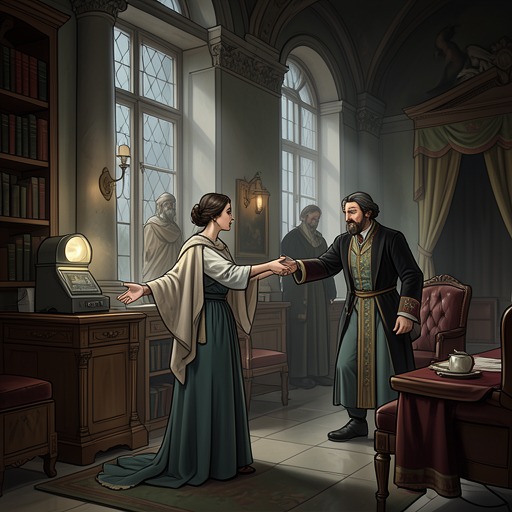
When the couple established their own household at the palace, their rooms and attendants were separated. Catalina’s rooms lay at the back, looking over the gardens and river, and were served by her household, Spanish ladies, chaplain, and duenna. Arthur’s rooms faced the City and had their own household, chaplain, and tutor. The two households met formally at dinner once a day, seated on opposite sides of the hall and watching one another with mutual suspicion. The division made the shared residence feel less like a united home than a carefully maintained truce.
Catalina’s letter to her mother describes the practical shortcomings behind the palace’s imposing name. Though Baynard's Castle Palace was a palace rather than a castle, it had no bathhouse for either women or men. Doña Elvira arranged for a blacksmith to make a large cauldron, which was heated in the kitchen and carried to Catalina’s room by six servingmen. The grounds offered no pleasure gardens of flowers, streams, or fountains; instead, there was a small knot garden in which a person could walk round and round. Catalina also complained of poor food, sour wine, preserved fruit, and the apparent absence of vegetables. She presented these as difficulties of her new surroundings, while insisting that she was content to be a princess.
The palace offered little privacy beyond a locked room. Men visitors and male servants came and went through the women’s rooms, which Catalina described as lacking seclusion. Her account makes the contrast between royal rank and personal space concrete: she could occupy rooms overlooking the gardens and river, yet found it difficult to be alone within her own household.
Household Rule and Significance
The residence was governed by Lady Margaret, the king’s mother. She set its feast and fast days, entertainments, and daily timetable, and even determined which nights Arthur would visit Catalina’s bedchamber. Once a week, members of the prince’s household and his friends escorted him to her rooms and left him there overnight. The arrangement placed the young couple’s private life inside a schedule administered by the older generation, while their households remained institutionally distinct.
Baynard's Castle Palace thus appears not simply as a backdrop to Catalina’s arrival, but as an ordered domestic environment where royal ceremony, dynastic expectation, and ordinary discomfort met. Its riverside gardens and formal halls announced the couple’s status; its divided rooms, scarce privacy, and externally imposed routines exposed the constraints of their new life. In Catalina’s account, the palace’s grandeur never entirely concealed how unfamiliar and isolating that life could be.